- Empathy & AI
- Posts
- The Fork in the AI Road is Here. Which Bet are You Making?
The Fork in the AI Road is Here. Which Bet are You Making?
Sharks will primarily use AI to cut. Sages will primarily use AI to grow. By 2028, the gap will be undeniable.

Alex Klein
March 10, 2026
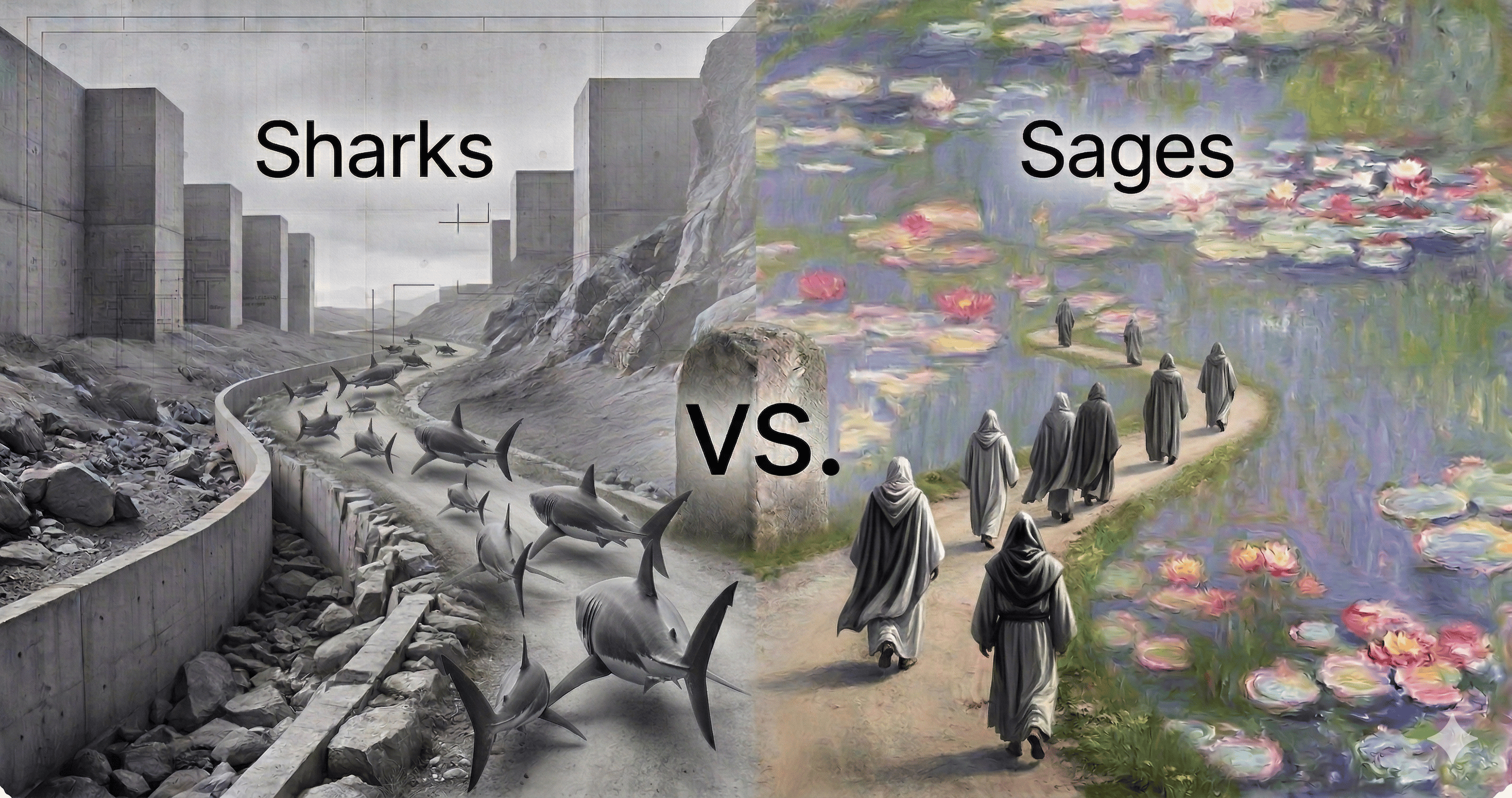
TL;DR: The question isn't whether AI changes everything. It's whether you use it to shrink or to grow.
It has taken me a couple weeks to overcome the sweaty panic induced by the Citrini Research memo.
If you missed the hyper-viral doomsday scenario, consider yourself lucky. The article was an anxiety bomb dressed up as economic analysis: companies gut their workforces, AI wins, everyone loses.
Once the panic subsided and my brain came back online, I remembered that black-and-white predictions are almost always wrong. The future is messier than that—and more interesting. What follows is my version: one that lives in the grey, and points toward something worth building.
The Fork in the Road: Shark or Sage?
In early 2026, the models took a step-function leap. AI could suddenly code and pull real workflow weight—reliably. And organizations realized that agents were real teammates capable of doing work, not just advanced search engines.
After a year of navigation and implementation, the first wave of responses was exactly what you’d expect.
First, a new breed of small companies emerged—“zero-human” enterprises that could operate at scale with a team of one or two. Then large companies began layoffs. Boards demanded efficiency programs. Block, Jack Dorsey’s fintech company, led the way, announcing a 40% cut to their staff in February.
The logic made sense at the individual firm level: cut headcount, redeploy savings into AI, maintain output at lower cost. By early 2027, roughly 60% of Fortune 500 companies were executing some version of this playbook.
But the other third made a different bet. A handful of executives noticed something the efficiency optimizers had missed: the companies cutting hardest were not actually outperforming. The margin expansion was real. The revenue growth wasn’t.
Without anyone quite naming it, a fork in the road had appeared. A competing worldview was born—one that became widely known as Sharks versus Sages.
The Competing Worldview
The Sharks, the 60%, took the obvious path: deploy AI to automate human work, replace headcount, and convert the savings. This was what markets had salivated over for years. The promise behind every AI pitch deck and Sam Altman’s nightly dreams.
The Sages took a different path. They deployed AI to make humans smarter and more strategic—giving employees the capacity to conquer new markets, new client relationships, and problems that had always been too hard to get to.
Sharks asked: how many humans can we eliminate? Sages asked: what can we do now that was previously impossible?
Both groups started from the same premise: AI had made routine knowledge work a commodity. The reports, the data processing, the workflow management—it turned out to be far more executional than genuinely intellectual.
The Sages took that realization somewhere different. They acknowledged that real innovation had become nearly impossible at large organizations. Not because people weren’t smart but because they were buried. With 80% of their time absorbed by decks and analyses and inbox management, it’s no wonder strategic thinking had come to feel like a luxury. Employees weren’t lacking intellectual talent. They were trapped by executional volume. Freeing them changed everything.
What the Sages Did, Specifically
They redesigned work instead of reducing it.
Rather than asking which tasks to eliminate, they reinvented roles entirely. They decomposed each position into its constituent parts, determined what AI could handle, and redirected the freed human capacity toward strategic value creation. The results reverberated through their organizations.
Take a mid-size specialty pharma company with three marketed products. They went from selling molecules to selling patient outcomes, and every function transformed in the process.
Sales roles transformed from product pushers to outcome architects. Freed from call reports and sample tracking, a rep started mapping the full patient journey and discovered 40% of patients were abandoning treatment due to gaps between infusion visits — not side effects. She designed a wraparound adherence service and signed three health systems that had been on the fence for years.
Strategy teams transformed from deck builders to market creators. Freed from quarterly business reviews, a commercial strategy lead started spending time with payer medical directors and learned they were desperate for real-world evidence on total cost of care. He built a value-based contracting model that tied reimbursement to patient outcomes and opened two new formulary positions within a year.
Finance teams transformed from reporters to architects of performance. Freed from gross-to-net reconciliations, an FP&A analyst dug into unit economics by channel and discovered the rebate structure was suppressing uptake in specialty pharmacy — their highest-adherence, highest-lifetime-value patients. She restructured the rebate tiers and net revenue per patient jumped 18%.
The pattern was consistent: when you give people back their time and redirect it toward genuine thinking, they find things that were hiding in plain sight.
They invested in human judgment.
Peer review. Domain apprenticeship. Institutional practices that turn a technically capable person into someone with genuinely good judgment. The Sages recognized something important: decades of pure execution had produced a workforce that had rarely been asked to actually think. The raw material was there. It simply hadn’t been exercised.
They built AI systems designed for collaboration, not substitution.
Their internal tools were designed to surface human attention at the right moment—not to route around human decision-making entirely. They built collaborative workflows that pulled in judgment strategically, treating human expertise as the point, not the bottleneck.
How It Paid Off
This is not a story about altruism. The Sage firms weren’t blind idealists. They made this bet because it drove more value.
The Sharks won a one-time step change in efficiency: lower cost, higher throughput. The Sages won a sustainable competitive advantage.
By 2028, the bifurcation was visible in the data. Sage firms weren’t optimizing what they already had—they were expanding what was addressable. New demand unlocked. New categories entered. Old problems finally solved because someone finally had the capacity to think about them properly.
The Sharks, meanwhile, were defending old markets with shrinking teams. Running leaner on leaner. And losing the talent war entirely.
The market eventually recognized something harder to quantify but easy to feel: there is a quality of interaction—an aliveness, a responsiveness, a sense of genuine expertise—inside a Sage company that customers felt the absence of with Sharks. The Sages set a new standard and forced the Sharks to make a choice: reinvest in people to compete, or keep losing the clients worth having.
You Are Reading This in March 2026
The S&P is near all-time highs. The fork has not yet appeared clearly in the data. Most firms haven’t made their bet explicitly yet—they’re still living in the comfortable ambiguity of the early adoption period, when efficiency gains and workforce investment aren’t yet in direct tension.
That tension is coming. When quarterly pressure arrives, one answer will feel obvious. The cuts will feel responsible. The efficiency program will have a name, a slide deck, and a timeline. It will feel like a strategy.
The question every leadership team needs to answer — before the quarterly pressure makes the answer feel inevitable:
What does our business become if we assume humans are an appreciating asset, not a depreciating one?
And here’s the part most leadership teams haven’t modeled: the firms that answer it correctly won’t just outperform. They’ll raise the bar for everyone else.
The companies that answer that question correctly in 2026 will be the case studies of 2028.
Ask Yourself
What problems have you given up on — not because they aren’t worth solving, but because no one ever had the bandwidth?
What are the most impactful roles that, if freed up, could transform your company?
What will your company look like in 3 years if every employee was 10x as powerful?
These are the questions we’re helping companies answer at Sage AI. We’ve spent 15 years helping Fortune 500s navigate their hardest innovation challenges. And now, for the first time, the tools exist to actually solve them. If any of this opened something up for you, we’d love to talk. [email protected]